
LangGraph
Open-source framework for building stateful, multi-actor LLM applications with graph-based workflows.

Áttekintés
Fő funkciók
- Graph-based agent orchestration
- Built-in state management and memory
- Multi-actor and multi-agent support
- Streaming and async execution
- Checkpointing for pause and resume
- Compatible with major LLM providers
Felhasználási esetek
Build Multi-Agent Collaboration Systems
Orchestrate multiple specialized agents that communicate and hand off tasks through graph-defined workflows, enabling complex problem-solving across roles like researcher, planner, and executor.
Long-Running Stateful Agents
Develop agents that maintain memory and persistent state across sessions, using checkpointing to pause, resume, and recover workflows without losing context.
Human-in-the-Loop Approval Flows
Insert human review checkpoints into LLM workflows for sensitive decisions, allowing reviewers to approve, edit, or reject agent actions before execution continues.
Complex Branching LLM Pipelines
Implement workflows with cycles, conditional branching, and retries that go beyond linear chains, giving developers fine-grained control over tool use and model routing.
Előnyök és hátrányok
Előnyök
- Fine-grained control over agent flow
- Supports cycles and complex branching
- Stateful execution with persistence
- Human-in-the-loop checkpoints
- Integrates with LangChain ecosystem
Hátrányok
- Steeper learning curve than simple chains
- Requires understanding of graph concepts
- Documentation can lag rapid releases
- Primarily code-first, no visual builder
Értékelések
Átlag 5 értékelésből.
Jelentkezz be értékelés írásához.
Ingrid Bauer
Skeptical, then convinced
I went in skeptical — most tools in this space overpromise. It actually delivers on multi-actor and multi-agent support, and fine-grained control over agent flow caught me off guard. Documentation can lag rapid releases is why this isn't a perfect score, still, I'd recommend giving it a real trial.
Ethan Brooks
Years in this space
I've evaluated a lot of these over the years. What stands out here is graph-based agent orchestration — handled better than most — and integrates with LangChain ecosystem. Worth the time if this is your use case.
Wei Chen
Years in this space
I've evaluated a lot of these over the years. What stands out here is multi-actor and multi-agent support — handled better than most — and fine-grained control over agent flow. Documentation can lag rapid releases is my one real gripe. Worth the time if this is your use case.
Kwame Mensah
Solid for our team
We rolled this out across the team last quarter and integrates with LangChain ecosystem. Built-in state management and memory fits neatly into how we already work, and multi-actor and multi-agent support removed a step we used to do by hand. Steeper learning curve than simple chains, which is the main caveat, but it has held up under daily use.
Fatima Zahra
Skeptical, then convinced
I went in skeptical — most tools in this space overpromise. It actually delivers on streaming and async execution, and stateful execution with persistence caught me off guard. Steeper learning curve than simple chains is why this isn't a perfect score, still, I'd recommend giving it a real trial.
Kérdések
Még nincsenek kérdések — kérdezz elsőként.
Kérdezz
Large Language Models (LLMs) alternatívái


Mistral AI
Large Language Models (LLMs)
Open-weight frontier models

Poe
Large Language Models (LLMs)
Unified chat interface for accessing multiple leading AI models in one place.

Afforai
Large Language Models (LLMs)
AI research assistant for querying, summarizing, and citing academic sources.

Seraphnet AI
Large Language Models (LLMs)
A decentralized platform for ideologically-transparent generative AI applications with a focus on privacy and unbiased outputs.

WebVoyager
Large Language Models (LLMs)
An LMM-powered web agent completing user instructions end-to-end by interacting with real-world websites.

Qwen Chat
Large Language Models (LLMs)
Alibaba's multi-model chat assistant for text, code, image, and document tasks.
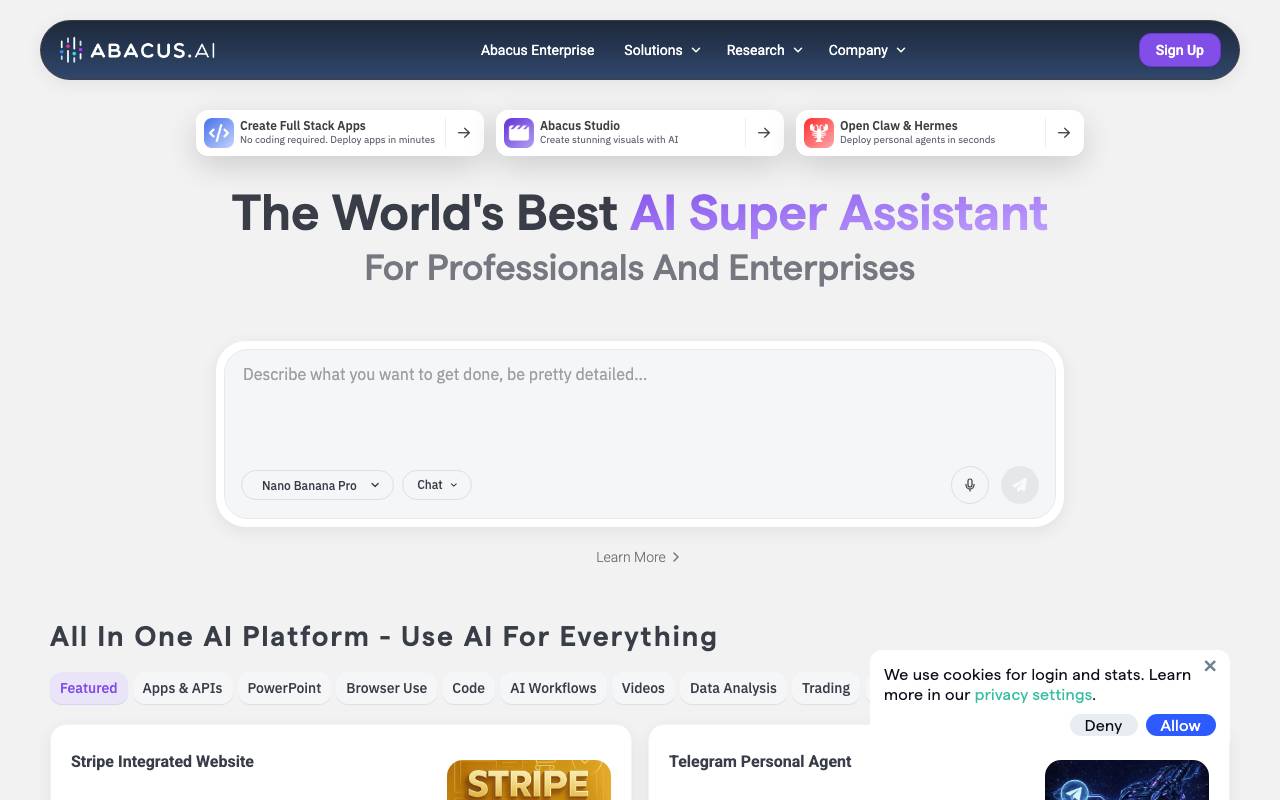

Abacus AI
Large Language Models (LLMs)
An AI platform offering advanced tools for building, deploying, and managing machine learning models and AI applications.
Rita AI
Large Language Models (LLMs)
Autonomous job search assistant that finds roles and submits applications for you.